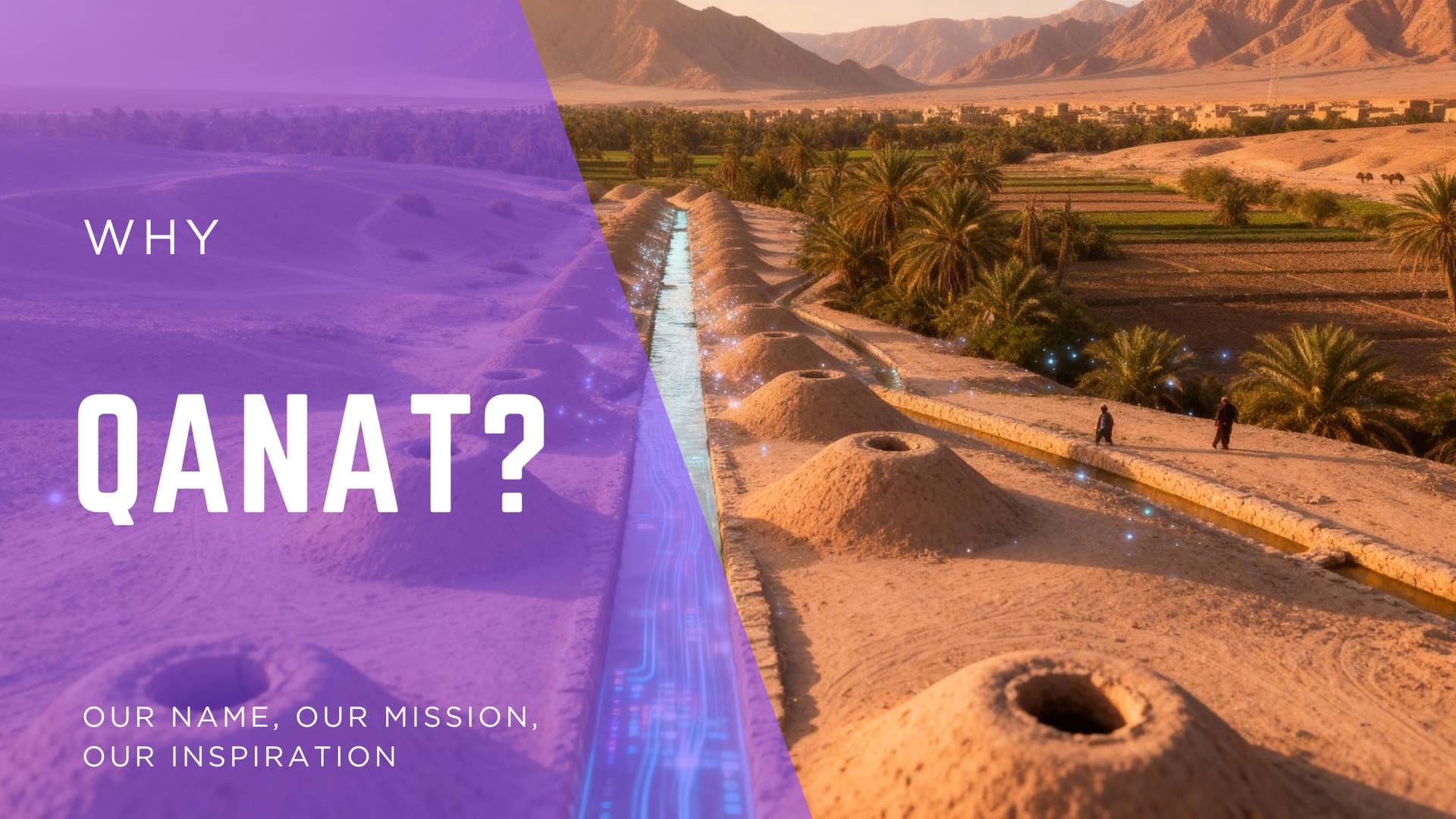
When tech pioneers named their companies after everyday objects — yearbooks, air mattresses, windows — they were connecting modern solutions to timeless human needs. We chose our name for a deeper reason: because the technology that inspired us has been solving one of humanity's most fundamental challenges for over 2,500 years.
The Ancient Engineering Marvel That Transformed Civilizations
To understand why we chose the name QANAT, we must journey back to the arid landscapes of ancient Persia. Picture vast stretches of desert where survival seemed impossible, where scorching sun and endless sand dunes offered nothing but desolation. Yet beneath this seemingly barren surface, ancient engineers discovered something extraordinary: underground water sources that could sustain entire civilizations.
The qanat system emerged around the first millennium BCE and spread throughout the Persian Empire, eventually reaching as far as Spain and Morocco. These underground channels weren't just engineering marvels — they embodied a philosophy that worked with nature rather than against it, creating sustainable solutions that lasted for centuries. What makes qanats truly extraordinary is their underlying approach to resource management and community empowerment.
Master qanat builders, known as "muqannis," would dig horizontal tunnels by hand, sometimes extending for dozens of kilometres underground. These tunnels followed the natural gradient of the land, allowing gravity to move water efficiently without external power sources. Vertical shafts were dug at regular intervals for construction access and ongoing maintenance, creating a sophisticated network resembling a subway system for water.
Decentralisation Before It Had a Name
The qanat system perfectly embodies principles we now associate with cutting-edge technology: decentralisation, sustainability, and community ownership. Unlike centralised water systems depending on single points of control, qanats created distributed networks that were inherently resilient. If one section faced problems, the rest continued functioning, ensuring communities never lost access to this vital resource.
Each qanat was typically owned and maintained by the communities it served, creating a direct relationship between stewardship and benefit. The people who depended on the water were the same people responsible for its maintenance, fostering deep understanding of the system's needs and a vested interest in long-term sustainability. This decentralised approach made qanat systems remarkably durable — while centralised empires rose and fell, qanat networks continued operating, some for over a thousand years.
They represented a form of technological resilience that modern systems, despite all their sophistication, often struggle to achieve. UNESCO has recognised traditional qanat systems as Intangible Cultural Heritage, acknowledging their unique combination of technical ingenuity and cultural significance. Today, over 37,000 qanat systems still operate across Iran alone, continuing to provide water to communities as they have for millennia.
The Digital Desert We Navigate Today
Today, we face a digital paradox that would shock previous generations with its invasiveness. Every day, each of us generates thousands of data points through our phones, searches, purchases, and social interactions. By the time a child turns eighteen, researchers estimate their digital footprint contains millions of data traces, often shared unknowingly by parents and platforms alike. These traces aren't harmless digital breadcrumbs — they shape opportunities, identities, and sometimes even life outcomes. Yet most of us have little to no control over this process.
Data is harvested silently, stored indefinitely, and resold without our awareness. Corporations build profiles so accurate they can predict our desires before we're conscious of them. Studies from the World Economic Forum highlight data misuse as one of the defining risks of our era, ranking alongside climate change and global inequality. Academic research shows digital footprints are increasingly predictive of mental health outcomes, employment opportunities, and even political participation.
The parallels between water scarcity in ancient deserts and data sovereignty in today's digital world are striking. Just as ancient communities needed reliable access to water to survive and thrive, modern individuals and organisations need reliable control over their data to maintain privacy, autonomy, and economic opportunity. And just as ancient qanat builders created ingenious systems to bring water to where it was needed, we're building digital infrastructure to restore data sovereignty to where it belongs — with the people who generate it.
From Muqannis to Digital Engineers
Like those ancient master builders, our team at QANAT is engaged in careful, systematic work to create infrastructure that serves communities rather than extracting from them. We're not building surface-level apps that provide the illusion of service while harvesting value underneath. We're constructing the deep channels — the cryptographic protocols, the decentralised identity systems, the privacy-preserving networks — that allow data to flow directly to where it's needed, under the control of the people who own it.
Our approach draws directly from qanat philosophy of working with natural systems rather than against them. Instead of competing with centralised platforms on their terms, we're creating alternative infrastructure enabling direct peer-to-peer data sharing and value exchange through our Web X ecosystem. Our mission is protecting every participant in virtual space from cybercrime, manipulation, and unwanted data monetisation from the very first second of interaction.
"Just as ancient muqannis dug by hand for months to reach water that would sustain a community for generations, we invest deeply in infrastructure that may be invisible to end users but transforms what's possible for them."
Building Technology for Self-Determined Generations
We believe data sovereignty shouldn't be a privilege enjoyed by a few, but a fundamental right accessible to all. Our vision is crystal clear: "One for All" — providing safe cyberspace for everyone to engage freely everywhere. Through our self-sovereign identity system (xQIdent) and Web X ecosystem, we ensure each user knows exactly what data is generated, how it's used, and under what conditions it may be monetised. No hidden clauses, no endless terms of service, no opaque algorithms working against user interests — just clarity and consent.
The qanat inspiration reminds us that true innovation often comes from looking backward as well as forward, from understanding how our ancestors solved similar problems with different tools. In an era of rapid technological change, timeless principles of community ownership, sustainable design, and local stewardship provide essential guidance for building technology that truly serves humanity.
We're not just building another app or platform — we're contributing to fundamental infrastructure that we hope will serve communities for generations to come, just as the original qanats continue to provide water to communities across the Middle East and Central Asia today. The story of QANAT is rooted in the wisdom of ancient qanats and directed at the challenges of our digital age. We chose our name to symbolise sustainability, fairness, and resilience, building our mission on "One for All" principles.
Our name is our promise: to build digital infrastructure as reliable, sustainable, and community-serving as the ancient water systems that inspired us. Through our xQIdent identity system and Web X ecosystem, we're ensuring that in the data age — as in the age of desert civilisations — communities retain control over the resources they need to thrive. Ready to join the movement toward digital self-determination? Join the QANAT Beta →