
Digital sovereignty for all
Your data flows through infrastructure you don't control. WEB X. OS changes that, without changing how you work. Here's how.
.png)
You mention something to a friend in passing and an hour later an ad for exactly that thing appears on your phone. You search for a product once and it follows you across every website you visit for the next two weeks. You store files on a cloud service and quietly wonder: who else can see these? These moments of unease are not paranoia. They are an accurate read of how the internet actually works.
Every tap is a transaction. Every sign-in feeds a profile. Every file stored, every message sent, every service used flows through infrastructure owned by someone else, governed by terms you agreed to without reading, monetized in ways you were never fully told about. The internet made life more convenient. It also quietly moved ownership of your digital life somewhere you can't reach.
WEB X. OS is built to close that gap. And it does it without asking you to give anything up.
It is a decentralized operating system by QANAT Technology that combines the usability of Web 2.0 with the the structural guarantees of Web 3.0, available first as an installable software layer and roadmapped as a full standalone OS for any device.
The X. in the name is intentional. It marks the crossing point between two eras of the internet that have, until now, refused to meet. Web 2.0 gave us convenience at the cost of control. Web3 promised sovereignty but delivered complexity. WEB X. OS is the bridge, and unlike most bridges, it doesn't ask you to meet halfway. It brings both sides to you.
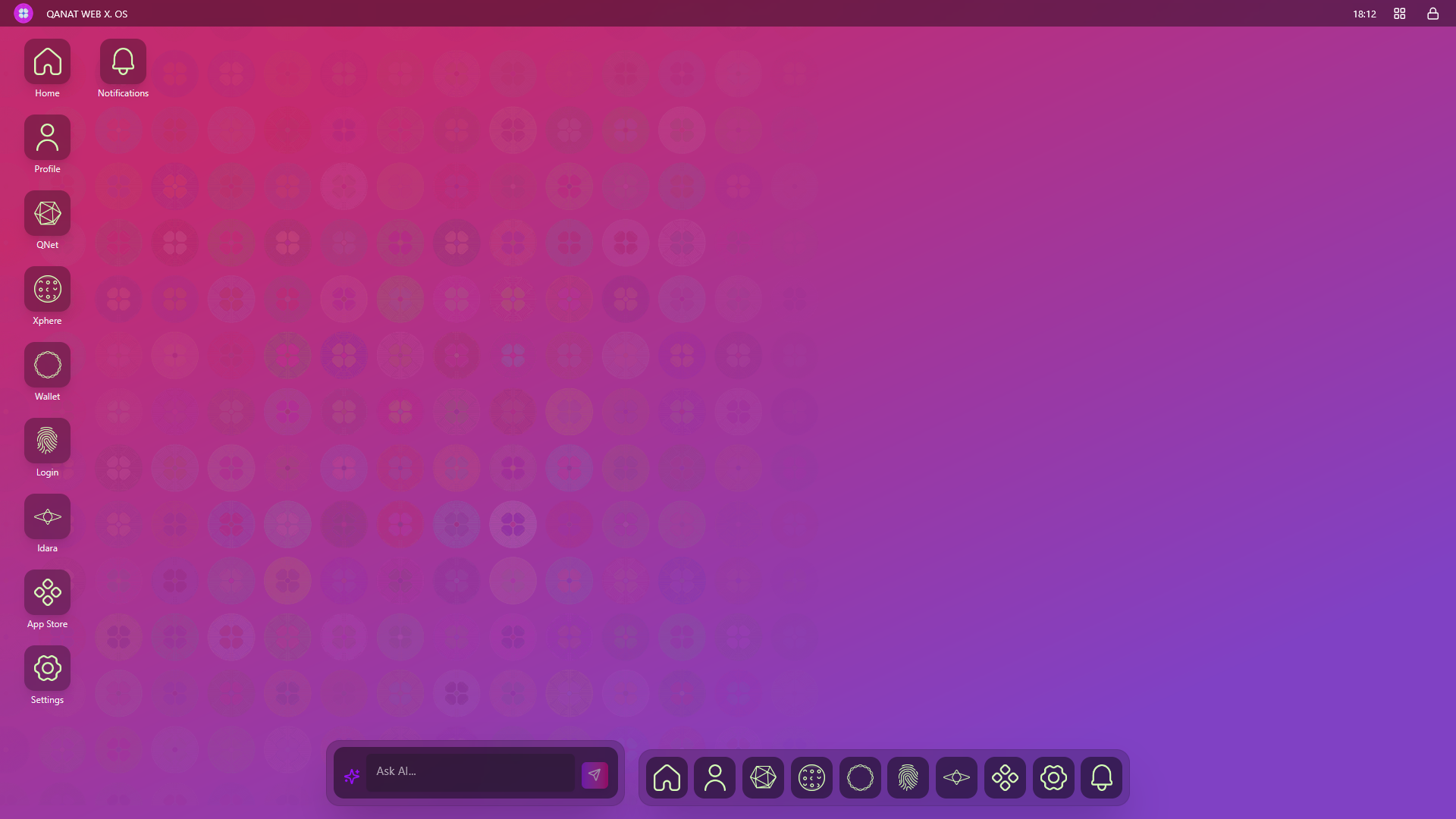
In practice, that means two things at once. First, an environment built on the usability principles and best practices people already know from the systems they use every day. Every interaction is designed to feel natural from the first minute, so anyone can work with WEB X. OS seamlessly, without a learning curve. Second, and more importantly, the tools and services you already rely on don't have to go anywhere. Your existing apps, cloud services, and workflows stay in place. What changes is the layer underneath them. WEB X. OS encrypts your data, gives you control over who can access it, and ensures that sovereignty travels with you across every service you use, including the Web 2.0 ones you were never planning to replace. The interface is familiar. The logic is familiar. But the architecture has fundamentally shifted in your favor.
Remember that ad that appeared right after you mentioned something in conversation? Or the file you stored somewhere and weren't entirely sure who else had access to it? Those aren't isolated incidents. They are the normal operating mode of the internet as it exists today. WEB X. OS changes the underlying conditions that make those things possible, and it does so in two ways that affect almost everyone differently.
For the individual, it means something that has not quite existed before: a digital life that is fully yours. Your identity, confirmed once and carried across every service without handing it to a third party. Your files, owned outright. Your conversations, private by architecture, not by policy. And your data, something you can choose to monetize yourself, rather than watching someone else profit from it on your behalf.
For businesses, the answer is just as direct: you don't have to change a thing about how you work today. The shift is significant, but it starts with that.
Most companies run on Web 2.0 software: CRM systems, cloud storage, collaboration platforms, productivity suites. Replacing them is not realistic, and WEB X. OS does not ask for that. Instead, it wraps the existing software stack in a sovereign encryption layer. Data is encrypted before it leaves the organization's environment. Access is managed through session keys that the organization controls, meaning it decides who can see what, and for how long, even when the data physically lives on a vendor's server.
In practice: a company continues using the same tools its teams have used for years. Nothing changes in the workflow. But the data that flows through those tools is now encrypted end-to-end, and access to it is governed by the organization, not the vendor. A cloud provider can no longer read data at rest. A breach at a third-party server exposes nothing meaningful. GDPR compliance stops being a legal exercise and becomes a structural property of the infrastructure. Sovereignty isn't negotiated. It's enforced by the architecture.
A different kind of problem: organizations that need to connect teams, locations, or partners across a private, secure network, without routing sensitive communications through centralized infrastructure they don't control. Traditional solutions, from VPNs to dedicated leased lines, are expensive, rigid, and still dependent on intermediaries somewhere in the chain.
With WEB X. OS, organizations can build their own distributed private network directly within the ecosystem. Locations connect peer-to-peer. Communications are encrypted at every node. The network is mission-specific, meaning it is built for exactly the purpose it serves and nothing else. No centralized server to compromise. No third-party provider holding the keys. The organization owns the infrastructure because the infrastructure is built on a layer it controls.
WEB X. OS includes an integrated Marketplace where apps, services, and data can be discovered, shared, and monetized directly within the ecosystem. This isn't an app store in the traditional sense, where a platform extracts a cut and sets the rules. It's an open economic layer where the value flows to the people who create it: developers who build tools, users who contribute data, businesses that offer services.
WEB X. OS is an open platform. Third-party developers can build their own applications directly within the ecosystem, and any app built on WEB X. OS inherits the same sovereign foundation: privacy, identity, and monetization capabilities built in from the start, not bolted on afterward. For developers, this means reaching users without rebuilding infrastructure. For users, it means every app in the ecosystem operates by the same rules, regardless of who built it. The platform enforces what most privacy policies only promise.
QANAT Technology is also developing its own suite of applications, extending WEB X. OS into both the enterprise and consumer space. Further details will be announced as development progresses.
What makes WEB X. OS different isn't any single feature. It's where it sits.
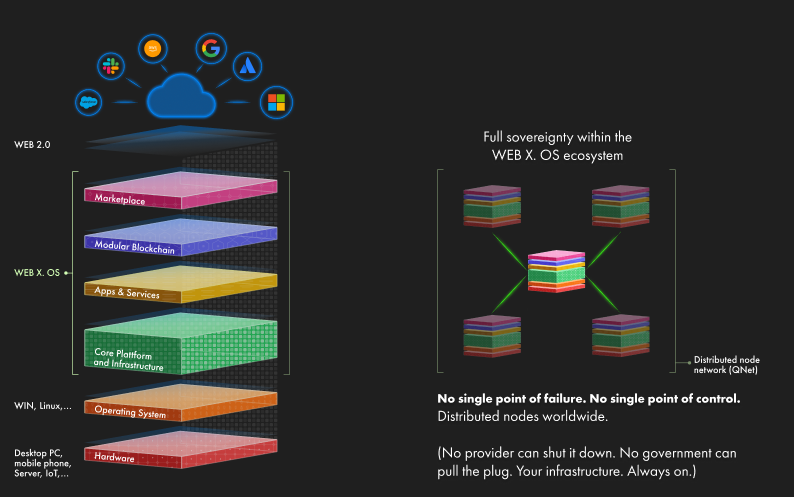
WEB X. OS positions itself underneath everything you already use. Your existing Web 2.0 tools, whether that's Google Workspace, Salesforce, Slack, or Microsoft 365, continue running exactly as they do today. The user sees nothing different. What changes is the layer beneath those tools: a sovereign infrastructure that manages identity, permissions, and data flows before any information reaches a third-party server.
The architecture is built in layers, from the hardware and operating system at the base, through the core platform and infrastructure, up through apps and services, and finally to the Marketplace where value is exchanged. Each layer is designed so that sovereignty compounds upward. By the time data reaches any application, it has already passed through an environment that encrypts it, controls who can access it, and logs every permission granted.
The network that holds this together is distributed by design. There is no single server to shut down, no single provider to compromise, no central authority that can pull the plug. Nodes operate worldwide, independently of one another, so the infrastructure remains available and uncensorable regardless of what any one actor decides. No single point of failure. No single point of control.
This is the difference between Web 2.0 and what comes next. Web 2.0 built convenience on top of centralization. WEB X. OS builds convenience on top of sovereignty. The experience feels the same. The underlying reality is entirely different.
The digital world is overdue for an operating system that works for the people using it, not for the platforms hosting it. WEB X. OS doesn't ask anyone to give up the convenience they've come to expect. It asks something more interesting: what would you do with a digital life that was genuinely yours?
That question is no longer hypothetical. The beta launches in Q2 2026. Following a community-driven feedback phase, the mainnet release follows approximately three months later. And the longer-term vision goes further still: a standalone Linux-based OS that replaces the existing operating system on any device entirely. Not an app running inside someone else's infrastructure. The infrastructure itself.
QANAT Technology is building the answer, and the first version is closer than most people realize. If you want to be part of what comes next, join the WEB X. OS beta at: qanat.io
Takeaway: WEB X. OS bridges Web 2.0 usability and Web 3.0 sovereignty without asking users to sacrifice either. It is an operating environment that looks familiar, works intuitively, and is built on an architecture that makes data exploitation structurally impossible. For individuals, it means a digital life that is fully theirs. For businesses, it means sovereignty and compliance without the overhead. For developers, it means building on a foundation that is already sovereign by design. The beta launches Q2 2026.
.png)
.png)
.svg)